

What Is a Mexico Tourist Card — and Do You Actually Need One?
I’ve entered Mexico more times than I can count — by land, by air and on foot. I’ve gotten an FMM — or a Mexico tourist card in airports, at border crossings and I even made an impromptu border run just to make sure I wasn’t overstaying my visit. Most people have never even heard of an FMM but they’ve almost certainly had one. So let me break this down.
What Is a Mexico Tourist Card or an FMM?
A Mexico tourist card, or an FMM aka Forma Migratoria Múltiple, is a tourist permit required for visitors entering Mexico. Think of it as your official record of entry. It documents who you are, how long you’re allowed to stay and what your purpose is for visiting.
It’s not a visa. US citizens don’t need a visa to visit Mexico for tourism and this is the very reason you need an FMM — it gives the Mexican government a way to keep up with you and monitor your border crossings and how long you stay in the country. It’s a permit that travels with your passport for the duration of your stay.
The confusion around whether or not you need an FMM stems from Mexico’s move to an electronic system — which is also why you’ll sometimes see it referred to as an EFMM, the E standing for electronic. The process has changed and that has led a lot of people to believe the FMM is no longer required but it still is.
Do You Need a Mexico Tourist Card or FMM?
Yes. If you’re a U.S. citizen visiting Mexico for tourism you need an FMM. Find yourself in Mexico without one and you are illegally in the country. But how you get an FMM — and whether you even notice getting it — depends entirely on how you enter the country.
Note: This article is for US citizens visiting Mexico as tourists. If you live in Mexico or hold temporary or permanent residency, you have a different process entirely — the FMM doesn’t apply to you.
Flying Into Mexico
Visiting Mexico requires a passport valid for the length of your stay. They do not enforce the six month rule but some airlines could deny boarding if you have less than six months remaining on your passport regardless of the destination’s requirements. Check your expiration date before you book, not after.
When you fly into Mexico, the FMM or tourist card, fee is factored into the cost of your airline ticket — you won’t be paying for it separately at the airport. In the past, the flight attendants handed out forms to fill out and present at immigration. The officer stamped the form, tore it in two and gave you half to hold onto.
Not anymore — the FMM is all done electronically. When you land, you’ll go through immigration, your passport gets stamped and your entry is recorded in the system. Most travelers don’t give it a second thought. (You still need to fill out a customs form)
That said not every airport in Mexico has fully converted to the digital system, so if you’re ever handed a paper copy at any point, hold onto it and turn it in when you exit just like before. Better safe than a headache at the gate.
Crossing by Land
This is where it gets a little more involved — and where some confusion happens too. Even though land crossings use the same system, they still use a paper FMM. There’s nothing to fill out but they stamp the paper and give you half to hold onto just like before.
If you’re crossing by land into Mexico for a short stay of 7 days or less, you typically don’t need an FMM. This is standard for day trips and quick border crossings.
If you’re crossing by land and plan to stay longer than 7 days, you need to get an FMM at the border. The FMM fee is currently approximately $54 USD as of January 2026 and immigration will stamp your permit with the number of days approved, up to 180. Note: you are not guaranteed 180.
What Happened When I Miscalculated Mine
I was in Tijuana for a conference and and when crossing on foot I told immigration I’d be there about a week. A few days in I realized I needed two more days for a press tour. I didn’t want to overstay — especially for a tourism event hosted by the government — so I took an Uber to the border, crossed into the US and re-entered Mexico to get a new FMM.
To be clear: I was not trying to avoid paying the fee. Nobody takes an Uber to the border twice to dodge $54. When I went back and explained the situation to the immigration agent they voided my original FMM, issued a new one and still didn’t charge me.
My best guess is that when I told them what I was there for they sized the new permit to fit the timeline and just handled it. The agents at the border are human. When you’re honest with them and clearly trying to do the right thing they tend to respond in kind. Ask for more time than you think you need. It costs the same whether they give you 8 days or 30.
Here’s why it matters at a land crossing in a way it simply doesn’t at the airport: when you fly into Mexico your return ticket is already in the system. Immigration knows when you’re leaving. There’s proof of onward travel built right into your booking.
When you walk across the border there’s nothing. No ticket, no reservation, no record of your plans. They have your word and that’s it. That’s why the length of stay conversation actually matters — and why being honest about your plans isn’t just the right thing to do, it’s the practical thing to do. The days on your FMM reflect exactly what you tell them.
Walking Across vs. Flying Out — An Important Difference
This is another tricky difference: If you walk across the border back into the US, Mexican immigration may not ask for your FMM. I’ve done it and they didn’t ask — I even stopped and asked an immigration agent on the Mexican side and was told they didn’t need it.
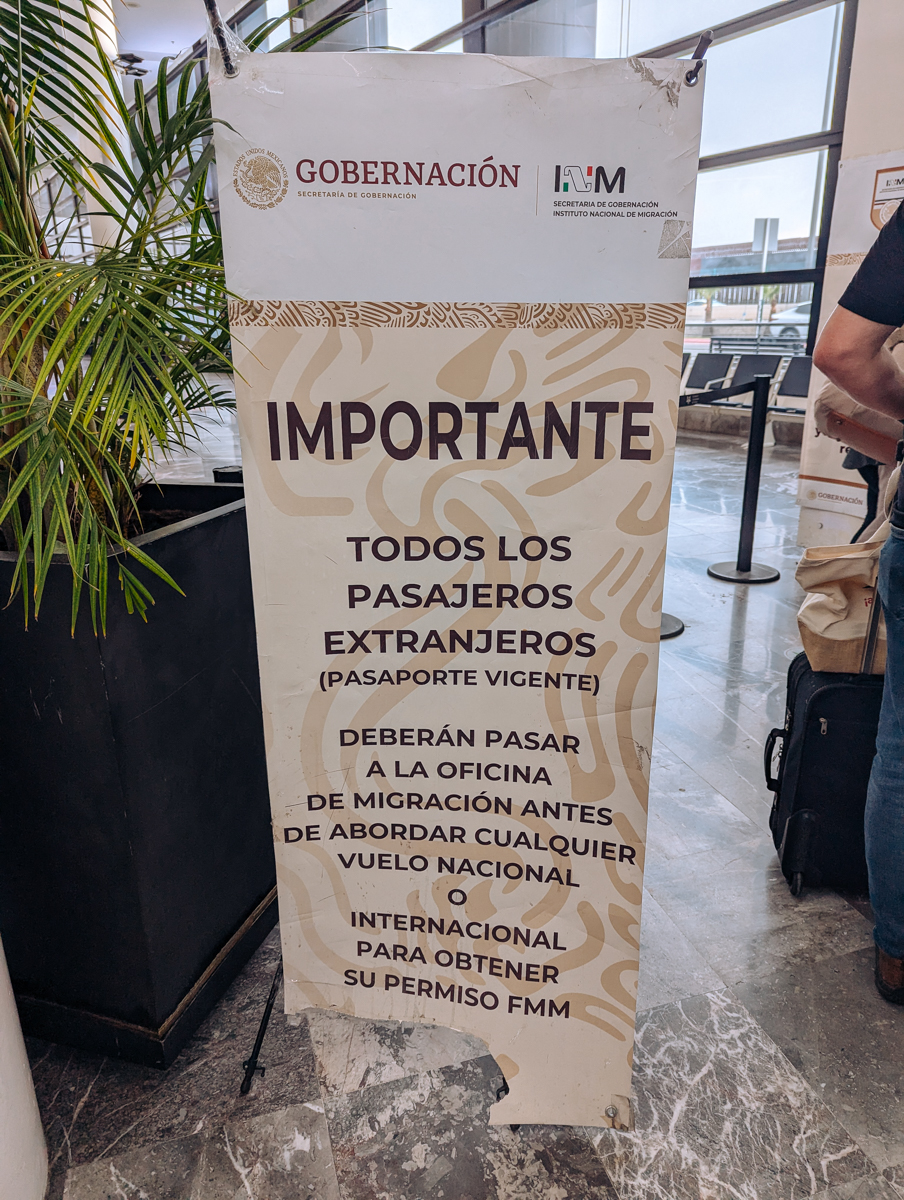
But if you fly out of a Mexican airport, they will ask for it. There are signs in the airports reminding you to have it ready — including one in Tijuana. I know because we missed it and an airline counter worker sent us back to handle it before we could check in.
Bottom line: keep your FMM, or Mexican tourist card, with your passport from the moment you get it until the moment you leave Mexico, regardless of how you’re exiting. It’s not worth the hassle of not having it.
The Digital FMM
Now to that electronic FMM: Mexico has rolled out a digital version of the FMM that can be completed online before you travel. It’s available through the official INM (Instituto Nacional de Migración) website. If you’re crossing by land and know you’ll need one, completing it in advance can save you time at the border.
Honestly, I don’t know how much time because the process is the process and the longest part of the crossing is waiting in line not the time spent obtaining an FMM.
A Note on Tijuana and Baja California
You may have heard that Tijuana is a “free zone” and wondered if that means you can skip the FMM. It doesn’t — at least not for the tourist card. The free zone designation applies to vehicle importation only, meaning you don’t need a Temporary Import Permit (TIP) to drive a foreign-plated vehicle in Baja California. That’s a separate thing entirely.
For the FMM, the same rules apply: short stays under 7 days in the immediate border area are generally fine without one, but anything longer requires it.
Mexico Tourist Card FAQ
How much does the Mexico tourist card cost?
Around $54 USD if you’re obtaining it at a land border crossing. If you’re flying, it’s included in your airfare.
How long is the Mexico tourist card valid?
Immigration will stamp it with your approved length of stay, up to 180 days. Always ask for the time you actually need.
What happens if I lose my FMM?
You’ll need to get a replacement before you leave. You can do this at an INM office in Mexico. Don’t wait until you’re at the airport — try to handle it as soon as you realize it’s missing.
Do I need a tourist card if I’m just crossing for the day?
Generally no, if you’re staying in the immediate border area for 7 days or less. But if there’s any chance you’ll venture further or stay longer, get one.
Do I need a tourist card if I’m driving into Baja?
You don’t need a Temporary Import Permit (TIP) for your vehicle in Baja California — that’s the free zone designation you may have heard about and it applies to vehicles only. You still need an FMM if you’re staying more than 7 days or traveling beyond the immediate border zone. Don’t confuse the two — they’re completely separate requirements
One More Thing About the FMM
The Mexico tourist card is one of those things that sounds more intimidating than it actually is. Fly in and you’ll barely notice it. Cross by land and just be honest about your plans, ask for the time you need and keep that card safe until you’re home. Mexico is worth every bit of the paperwork.
Always verify current requirements before you go — the process has evolved and what was true a couple of years ago may have changed. The rules, prices and details usually change every year.
Have questions about planning your Mexico trip? I’d love to help. Fill out my trip request form or email me directly.
Here’s even more Mexico from Southerner Says:
Is Mexico Safe for Travel
Things to Know Before Visiting Mexico
5 Essential Apps for Traveling in Mexico
25 Best Places to Visit in Mexico
See you south of the border!

Author: Lori Blalock
A girl raised in the South, Lori is the founder of Southerner Says and is a travel advisor who’s road tripped all 50 states and visited over half of the Mexican states. Passionate about national parks, sunsets and good barbecue, she writes about and helps others plan adventures in the U.S., Mexico and Caribbean. Georgia is home — but she’s rarely there.